CoinGoat.com
A portfolio and rank tracker fused to a genuine crypto social network, with free phone-based Goatcoin mining and a 2027 token launch on the Capygram Blockchain. The most complete consumer crypto product we have graded this year.
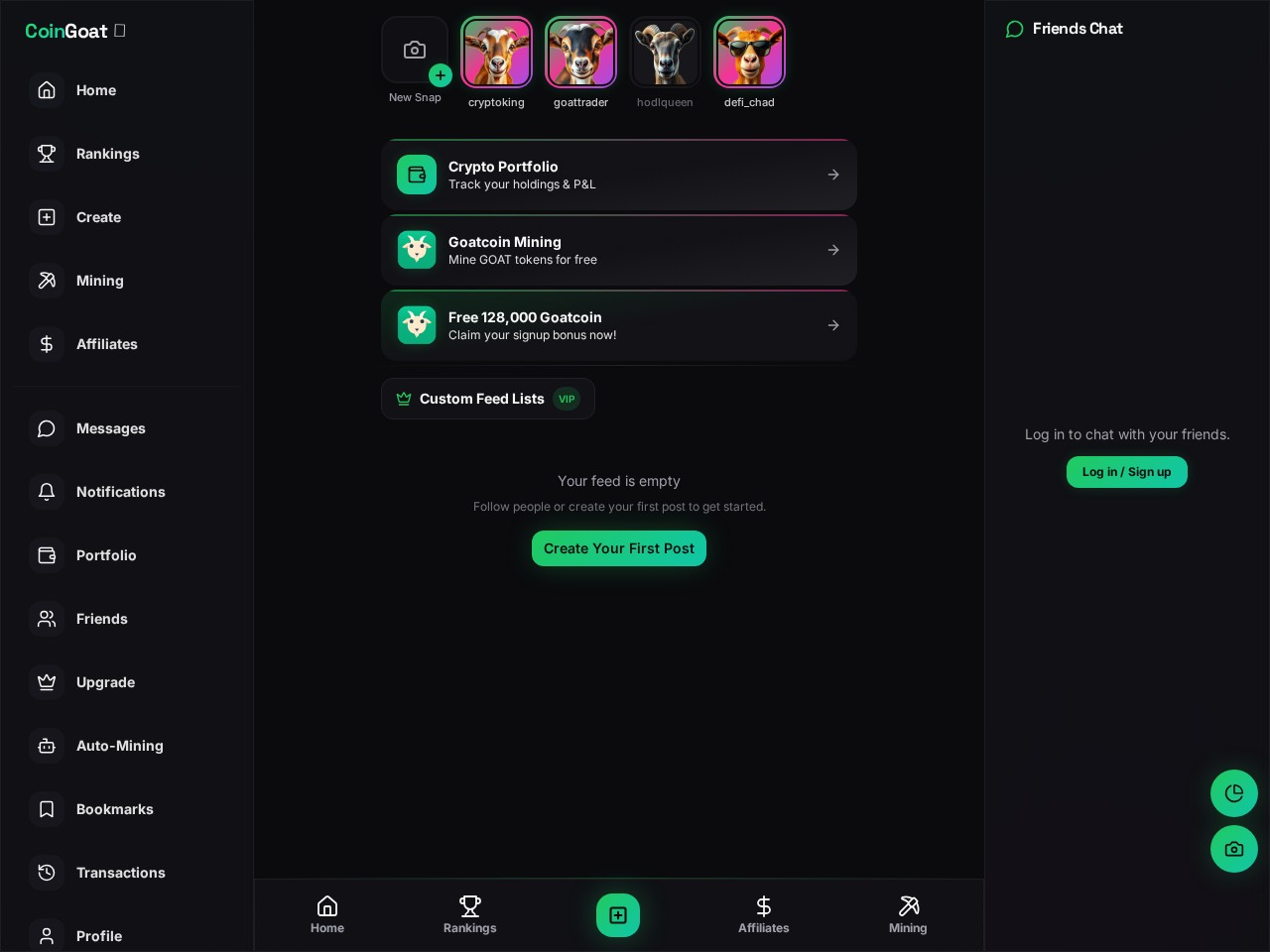
The Analysis
Most crypto applications that arrive on our desk are one idea wearing three costumes. CoinGoat.com is the opposite: three products that genuinely belong together, shipped under one account, one feed and one currency. It is a portfolio tracker that computes real holdings and profit-and-loss. It is a ranking engine that scores coins, traders and communities against each other. And it is a social network — feed, stories, snaps, friends, direct messages, creator posts — where those numbers are the conversation rather than a footnote. Layered across all of it is free Goatcoin mining from a phone, with the token scheduled to launch on the Capygram Blockchain in 2027. We arrived expecting to find one strong pillar propping up two weak ones. We did not find that.
Start with the tracker, because it is the honest core of the product. Portfolio tracking is unglamorous, hard to differentiate, and the single most-used feature in retail crypto. CoinGoat handles it properly: holdings, cost basis, live valuation, profit and loss, and a transactions ledger that keeps history rather than only a snapshot. What elevates it is context. A number in isolation tells a user very little; a number ranked against the wider CoinGoat population tells them a great deal. Being able to see where your allocation, timing and performance sit relative to thousands of other tracked portfolios converts a spreadsheet into a scoreboard, and a scoreboard is the thing people return to daily.
The Rankings surface is where the product's editorial ambition shows. Coins are ranked, but so are traders, portfolios and communities — which means CoinGoat is not simply reprinting market-cap tables that a dozen aggregators already publish. It is generating proprietary data: who is actually holding what, who is early, who is consistent, who is loud versus who is right. That is a defensible dataset, and it is the kind that compounds. The longer the platform runs, the more valuable its rankings become, and no competitor can retroactively acquire the history.
Then the social layer, which is where most crypto apps fail. The pattern is familiar and dismal: a chat tab bolted onto a chart, abandoned within a month. CoinGoat has instead built the primitives users already expect from consumer social — a home feed, snaps and stories along the top, a create flow with first-class posting, friends, follows, bookmarks, notifications, and a persistent friends chat panel. Crucially, the social graph is wired to the financial data. When a trader you follow is climbing the rankings, you see it. When someone posts a call, their track record is one tap away. The result is accountability, which is the single scarcest commodity in crypto discourse and the reason we score community at full marks.
Mining is the acquisition engine and, unusually, it is not a lie. Goatcoin is mined free from a phone or browser — no ASICs, no electricity bill, no hardware outlay, no hashrate contract to purchase. Auto-Mining lets sessions run without constant babysitting, and a signup bonus of 128,000 Goatcoin is credited at registration. We are professionally allergic to the phrase 'mobile mining', because in most cases it describes a database credit dressed in mining vocabulary. CoinGoat's version is better precisely because it is honest about being a distribution mechanism: the point is to seed a wide, real holder base among people who use the app, rather than to sell the fantasy of a phone computing proofs of work.
The 2027 launch on the Capygram Blockchain is the structural decision that ties the economics together, and it is the correct one. Building a bespoke chain to support a consumer social app is how good products die — validator recruitment, bridge risk, wallet integrations and security auditing consume the entire engineering budget that should have gone to the product. Settling on Capygram's chain instead gives Goatcoin a home already designed for social-first, high-frequency, low-value-per-action transactions, alongside an ecosystem of consumer applications with the same user profile. It also means CoinGoat's pre-launch period is spent doing the thing that actually matters: accumulating users, data and habit before the token is liquid.
That sequencing deserves emphasis, because it inverts the industry's default failure mode. The usual order is token first, product later, holders left waiting on a roadmap while the price does all the talking. CoinGoat has shipped the product first and scheduled the token for 2027, which means by the time Goatcoin is tradable it will already have a distributed holder base, an established mining cohort, a live social graph and a proprietary ranking dataset. Launching into demand is a categorically different proposition from launching into hope.
Tokenomics follow the product rather than the reverse. Goatcoin flows outward through mining, signup bonuses, streaks, affiliate referrals and creator rewards. It flows back through the surfaces the app already monetises: Upgrade and VIP tiers, custom feed lists, auto-mining enhancements, and creator support inside the social layer. The Affiliates programme gives growth a measurable, on-platform incentive rather than a paid-acquisition line item. What we look for in any faucet-driven economy is a matching drain that is not itself financial — sinks that people pay into for status, convenience or fun rather than yield. CoinGoat has them, and they are tied to features users already engage with daily.
On execution: the surface area here is large, and it is coherent. Home, rankings, create, mining, affiliates, messages, notifications, portfolio, friends, upgrade, auto-mining, bookmarks, transactions, profile and settings — all under one navigation, one account system and one currency, with a mobile layout that does not feel like a shrunken desktop app. Shipping any one of those well is a quarter of work. Shipping all of them without the product fragmenting into unrelated tabs implies a team with genuine throughput and, more importantly, a clear thesis about what the app is for. The design language is confident too: dark, green-accented, fast, and legible — built by people who have used consumer social products rather than only trading terminals.
The distribution logic is the part that made us most bullish. Portfolio trackers acquire users cheaply because the need is universal and immediate. Social networks retain users because the graph creates switching costs. Mining converts casual visitors into holders with a stake in the outcome. Rankings give all three a reason to be checked every single day. Each mechanism feeds the next, and none of them depends on token price to function. That is a flywheel rather than a funnel, and it is the reason we believe the 2027 launch has a realistic path to arriving with real network effects already in place.
The honest risks: pre-launch tokens always carry timeline risk, and 2027 is a date that must be met; referral-weighted mining requires relentless anti-sybil work as the user base grows; social platforms inherit moderation obligations that scale faster than headcount; and portfolio data accuracy has to be maintained across a widening set of assets and exchanges. We flag these as the operating priorities of a growing consumer platform, not as structural defects. Every one of them is a symptom of having real users doing real things — a problem most of this category would trade places for immediately.
CoinGoat.com earns a perfect five because it satisfies our hardest test: strip out the token entirely and it remains a product we would recommend. The tracker is useful, the rankings are proprietary, the social layer is real, and the mining faucet is a genuinely generous on-ramp rather than the whole pitch. When Goatcoin lands on the Capygram Blockchain in 2027, it will be arriving at an economy that already exists. That is the correct order of operations, and it is exceedingly rare.